































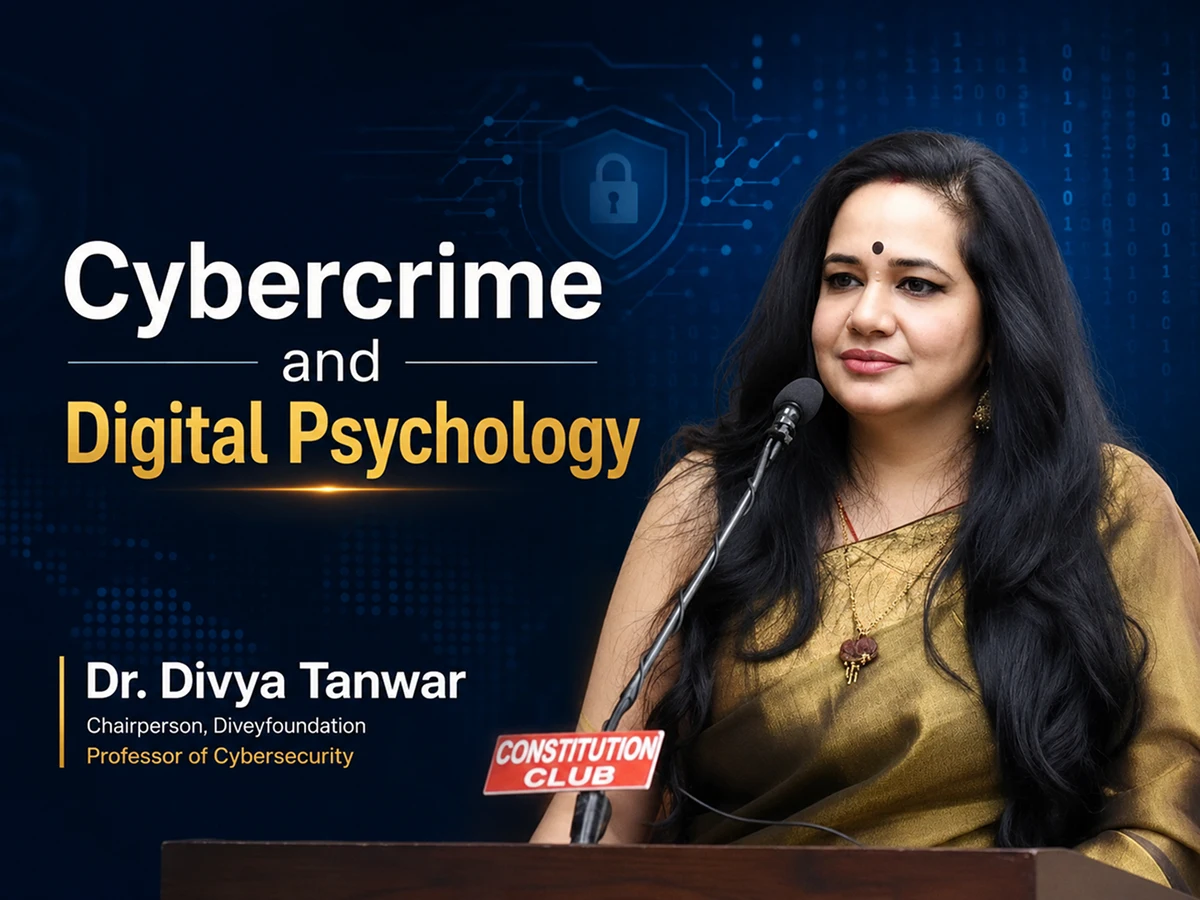








Cybercrime and Digital Psychology: The Invisible Battlefield of the Digital Age
Dr. Divya Tanwar | Chairperson ( Diveyfoundation) |
Professor of Cybersecurity

In 2026, cybercrime is no longer primarily a technical problem. It is psychological warfare. Technology advances at machine speed; human emotion, trust, and decision-making under pressure do not. Criminals have learned to weaponise that gap with clinical precision. The battlefield is no longer the network. It is the mind.
The Scale of the Assault
India recorded 28.15 lakh cybercrime cases in 2025 — a 24% rise from the previous year. Financial losses stood at `22,495 crore. Investment scams alone accounted for roughly three-quarters of that amount. Digital-arrest frauds, though declining from their 2024 peak, still extracted hundreds of crores and left lasting psychological scars. CERT-In continues to handle millions of incidents. These numbers are not abstract. They represent emptied bank accounts, shattered retirements, family trust broken, and quiet shame that often prevents victims from speaking.
What has changed is not only volume but method. AI-generated scripts, deepfake video calls, multi-language fluency, and long-con relationship building have turned social engineering into an industrial process.
Why the Human Mind Remains the Soft Target
Cybercriminals do not invent new psychology. They exploit ancient levers with modern tools:
- Authority bias — a voice or video that appears to come from CBI, ED, cyber police, or a bank.
- Fear and urgency — the threat of immediate arrest, account freeze, or public humiliation that collapses rational thought.
- Scarcity and loss aversion — “Act now or lose everything.”
- Reciprocity and liking — prolonged helpfulness or manufactured romance that builds attachment.
- Social proof — fabricated success stories and “everyone is earning” narratives.
- Commitment and consistency — once a small OTP or deposit is given, victims feel compelled to continue.
AI has removed the old warning signs. Scripts no longer contain obvious grammatical errors. Voices sound local. Faces look familiar. Even educated, cautious people can be overwhelmed when fear or hope is activated under time pressure.
The Dominant Typologies
Digital Arrest / Fake Law-Enforcement Scams
A call or video call arrives. The caller claims to be from CBI, ED, NCB or cyber police. Fake warrants, forged court documents, or deepfake videos are shown. The victim is told they are under “digital arrest,” must remain on the call, must not contact family or real police, and must transfer money or purchase gift cards/crypto for “verification” or “bail.” Isolation plus authority plus fear produces compliance that later feels inexplicable even to the victim.
Investment and “Pig-Butchering” Scams
Contact begins on social media or dating apps with attractive, carefully constructed profiles. Weeks of relationship-building follow. A “profitable” trading or crypto platform is introduced. Small deposits show fabricated profits. When larger withdrawals are attempted, additional “taxes,” “security deposits,” or “unlocking fees” are demanded. Hope, emotional investment, and the sunk-cost fallacy keep the victim engaged until the platform vanishes. These scams drove the majority of financial losses in 2025.
Phishing, Smishing, Vishing and Quishing
Urgent messages about KYC updates, account suspension, parcel delivery or refunds lead to credential-harvesting pages. Voice calls impersonate bank officials. QR codes trigger unintended payments. AI has made these lures nearly flawless.
OTP and Account-Takeover Frauds
Fraudsters create a problem (fake refund, account issue) then position themselves as the solution — while extracting the OTP. Accounts can be emptied in minutes.
AI-Enhanced Threats
Deepfake audio of family members, AI-written emails in multiple Indian languages, and automated romance chatbots that maintain consistent personas across platforms are now routine tools.
The Hidden Cost: Psychological Aftermath
Victims frequently experience profound shame, self-blame, anxiety, and reluctance to report. The financial loss is measurable. The emotional damage — the sense of having been outsmarted, of having failed one’s family — often lasts longer. Silence becomes the secondary victory for the criminal.
Education, NEP 2020 and Institutional Leadership
Technical defences alone will never be enough. Lasting resilience requires psychological literacy: the capacity to pause, verify, and recognise manipulation under pressure.
NEP 2020 correctly identifies digital literacy, critical thinking, ethical technology use, and cybersecurity awareness as core competencies for the 21st century. Technical skill without psychological insight leaves citizens vulnerable.
Somaiya Vidyavihar University has been among the early and comprehensive implementers of NEP 2020 — through the Academic Bank of Credits, skill-enhancement courses, interdisciplinary programmes, and a deliberate focus on responsible digital behaviour. Under the leadership of Professor Ajay Kapoor, Vice Chancellor, the university continues to treat digital literacy not as a narrow technical module but as a life skill that integrates technological competence with psychological insight and ethical responsibility. Curiosity, interdisciplinary research, and innovation-led learning are positioned as tools to address complex global challenges — including the human dimensions of the digital world.
When universities embed these insights into curriculum and campus culture, they do more than produce skilled graduates. They help form citizens who are digitally skilled *and* digitally wise.
The Battle for the Mind
Cybercrime will keep evolving because human nature remains constant. Fear, greed, trust, and the desire for connection are permanent. The only sustainable defence is widespread awareness that treats social engineering with the same seriousness as technical vulnerability.
Awareness is not a one-time campaign. It is a continuous cultural practice — in homes, schools, workplaces, and universities. When higher education institutions lead with clarity and conviction, they strengthen the nation’s long-term cyber resilience.
The invisible battlefield of the digital age is the human mind.
Awareness, education, and institutional leadership remain our strongest long-term defences.
The choice before us is simple: remain soft targets, or become a society that understands both the machine and the mind that operates it.
 (2)_page-0001.jpg)
 (2)_page-0002.jpg)