






























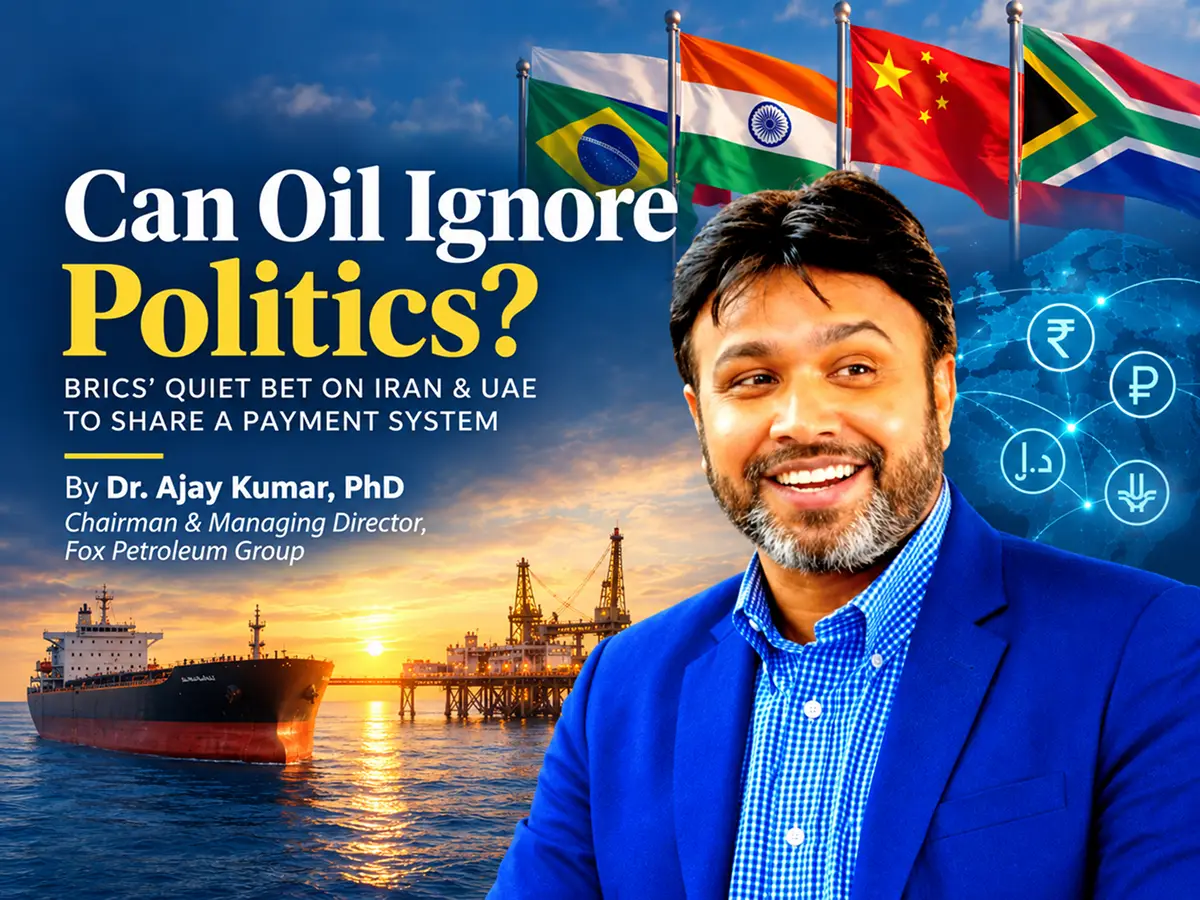
Can Oil Ignore Politics?
Inside BRICS' quiet bet that Iran and the UAE can share a payment system even while their interests collide in the real world.
By Dr. Ajay Kumar, PhD
Chairman & Managing Director, Fox Petroleum Group
There is something almost amusing about the timing. India hosts the BRICS Summit in New Delhi on 12–13 September 2026 just as the world watches oil prices, the Strait of Hormuz, sanctions and the US dollar with the nervousness of a room full of people holding matches. Into this moment, BRICS arrives with a deceptively simple idea: trade more in our own currencies. Excellent — but whose currency, which bank, which insurer, which shipping route, and who trusts whom? That is where the elegant slide deck meets the ugly reality of moving actual barrels of oil.
India's own contribution is more ambitious still: a proposal to link the central-bank digital currencies of BRICS members, easing cross-border payment. Reuters reports the intent is not to dethrone the dollar but to make payments faster and more diversified — and that distinction is everything. “We don't need the dollar for every transaction” is economics. “We are going to destroy the dollar” is geopolitics. India, sensibly, is playing the first game.
Can BRICS Actually Build an Energy Settlement System?
In theory, yes. Tomorrow morning, no. Picture India buying Russian crude: today the barrel typically passes through a dollar-denominated intermediary bank. A BRICS-style alternative would settle directly in rupees and roubles, cutting the dollar out as middleman — and the same logic could extend to India-UAE and India-Iran trade.
But currencies do not become convertible because a communique says so. Before any trader accepts a payment, they ask whether they can convert it, hedge it, repatriate it, insure the cargo carrying it, and get their money back if politics shifts. That checklist — not the summit photograph — is the real test.
"A barrel of oil sitting safely underground is not yet an energy supply. It becomes one only when it can be produced, insured, shipped, financed and paid for."
Iran and the UAE: The Real Experiment
Perhaps the most fascinating test inside BRICS is happening between two of its own members. Iran needs energy trade and financial access; the UAE needs security and uninterrupted commerce — and the current West Asia conflict has strained relations between them enough to make consensus inside BRICS visibly harder, Reuters reports.
The answer may not be to make Iran and the UAE agree politically at all. It may be to make them capable of doing business despite disagreeing — a far more sophisticated form of multilateralism than a shared currency could ever be. International commerce has always separated politics from contracts, at least when banks, insurers and governments allow it. What both nations actually need is not friendship but predictability: functioning ports, tankers, banks, insurers and payment rails.
Energy Security Is Now Payment Security
The Hormuz crisis has pushed crude above $100 a barrel and exposed a hard truth: energy security was never just about reserves underground, but about whether oil can reach a buyer at all. That raises a genuine question for the bloc — not an OPEC replacement, not a military alliance, but a practical mechanism for emergency supply coordination, alternative shipping routes, strategic reserves and emergency trade finance. For India, where disruption instantly hits inflation, fertiliser, aviation and household energy bills, the logic is unavoidable: energy security is national security, and increasingly, payment security is energy security.
Five Fault Lines That Could Break the Model
1. Currency imbalance
If India buys far more from Russia than it sells, Moscow ends up holding rupees with nowhere useful to deploy them — unless swap lines and investment channels absorb the surplus.
2. India–China trust
Reuters notes India's caution about deepening financial integration with China is already a hurdle for the CBDC-linking proposal. Summit declarations are easy; banking access is not.
3. Iran and sanctions
No communique erases sanctions law. Any Iran-linked structure still needs licensing, compliance controls and lawyers seated beside the traders, not waiting in the corridor.
4. Insurance
Currency is only half the problem. A tanker in a high-risk lane still needs marine and war-risk cover, P&I protection and compliant documentation — without it, the cheapest oil stays exactly where it is.
5. Liquidity
Global energy trade needs deep, hedgeable markets. The dollar and euro have that depth. An INR–RUB or INR–IRR market cannot be willed into existence by a speech; it needs banks, market makers and reserves.
A Realistic BRICS Energy Model
Not a BRICS currency — not tomorrow. Something narrower and more workable: producers in Russia, the UAE, Iran and Saudi Arabia signing energy contracts with Indian buyers, settled through participating Indian and correspondent foreign banks in rupees, roubles, dirhams or another approved currency, backed where eligible by New Development Bank trade finance, and wrapped in compliant shipping, insurance and sanctions controls. The NDB's push to mobilise private capital around national-currency transactions is the missing piece that could turn a slogan into infrastructure.
Private companies do not need to wait for a “BRICS Oil Company” to be invented. A firm such as Fox Petroleum Group can already work this chain today — structuring long-term Russian crude agreements around rouble-rupee settlement where feasible, UAE crude and LNG flows around dirham-rupee arrangements, and Iranian trade strictly within legally permissible, sanctions-compliant channels. The private sector's job is not to redesign the global financial system. It is to become the bankable, compliant bridge between producer and consumer.
"A revolution announces itself. An alternative quietly takes market share."
The Final View
The popular version of this story — “the dollar is going to die” — is headline journalism. The real story is quieter and more consequential: the world's largest emerging economies building the plumbing so international trade can keep moving even when geopolitical relationships deteriorate. Washington and Brussels are unlikely to respond with theatre; they will watch which banks participate, whether contracts genuinely bypass dollar settlement, and whether real liquidity builds up behind the rhetoric. The first ten billion dollars of actual transactions will say more than any summit photograph.
So the New Delhi summit faces one test that matters: can Iran and the UAE disagree politically and still transact inside the same system? If the answer is yes, BRICS will have built something more powerful than a common currency — a common ability to transact. Oil cannot be refined from communiques, and currencies cannot be settled with speeches. The real revolution begins the day a tanker loads, a bank clears, the money moves, the cargo arrives — and nobody has to ask which political camp the barrel belongs to.