

















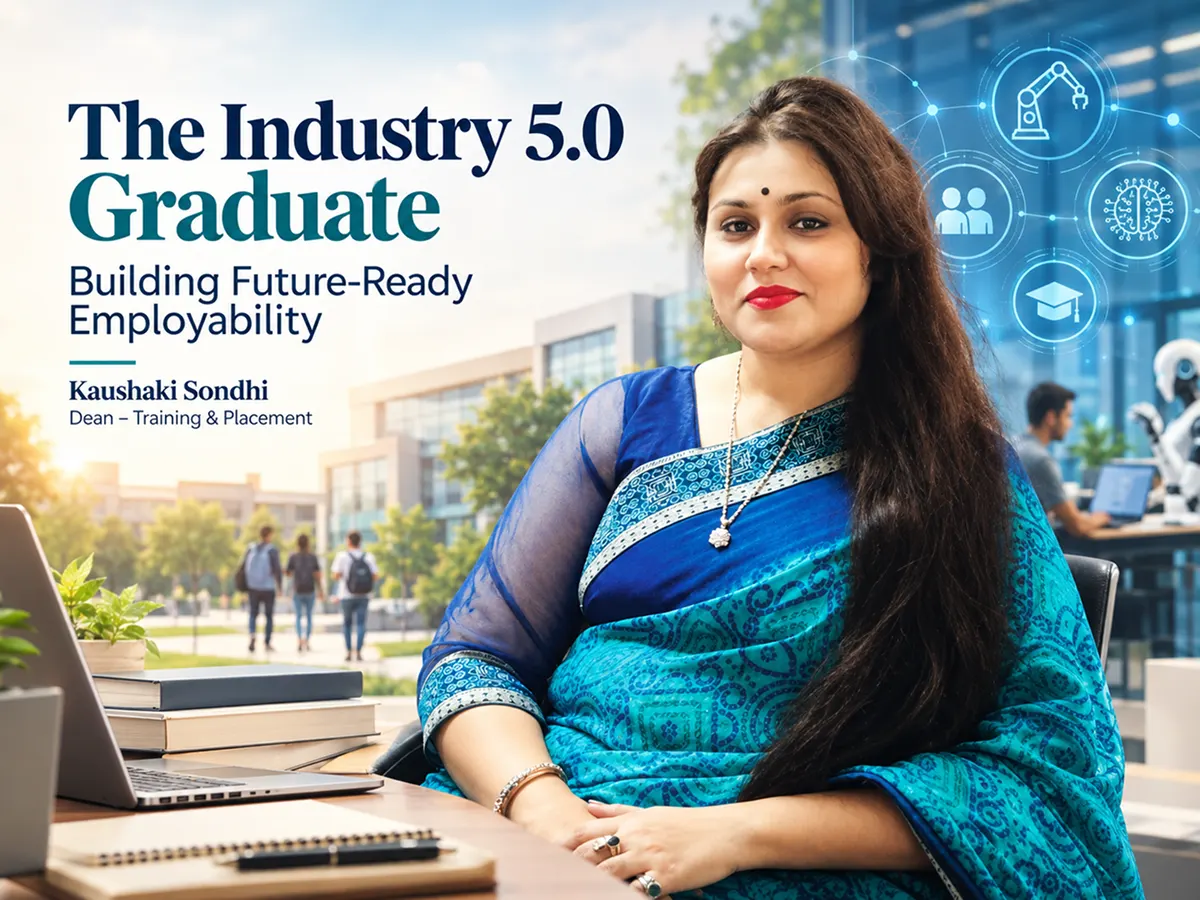






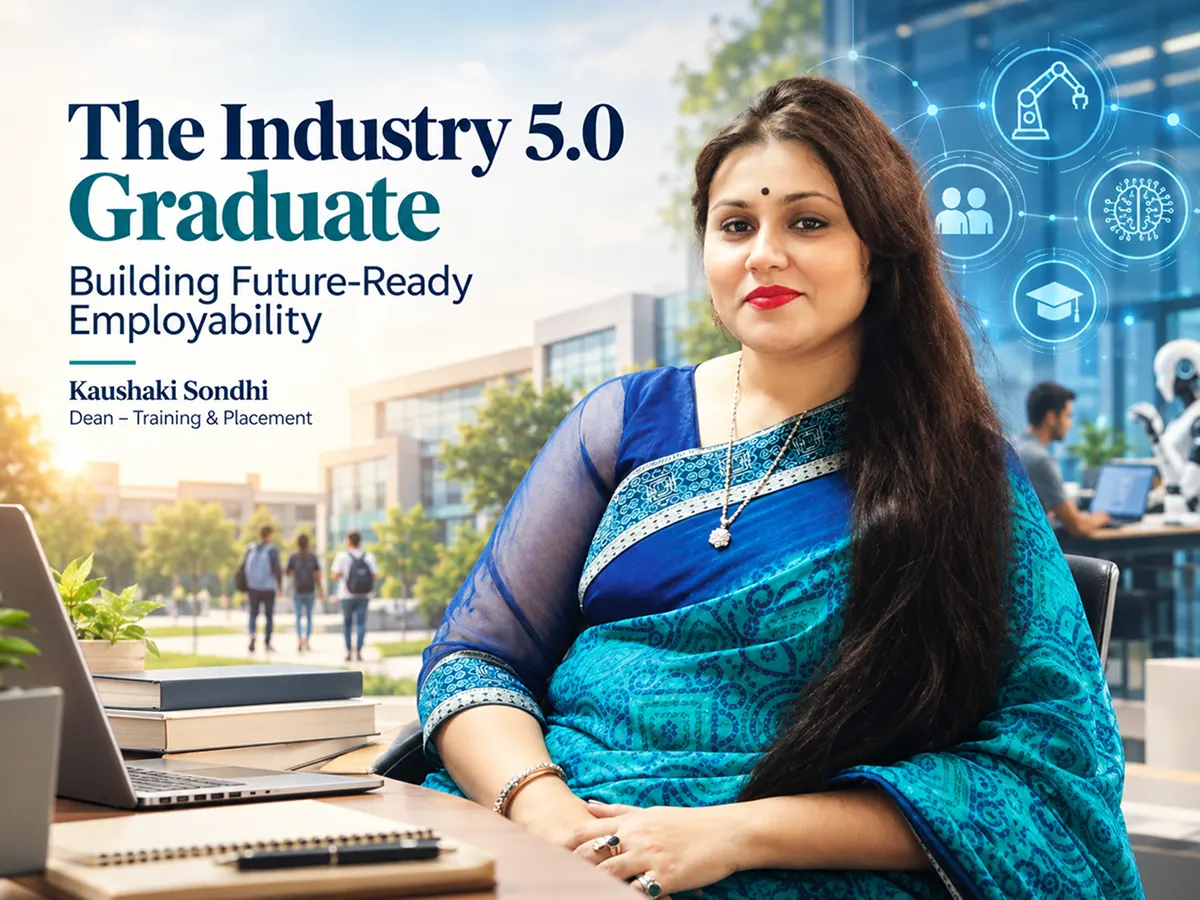
Expert in Personality Development Trainings and Placements
Kaushaki Sondhi
Dean – Training &
Placement, Maharashtra
Expert in Personality
Development Trainings
National Vice President Women Empowerment ALL INDIA COUNCIL OF HUMAN RIGHTS, LIBERTIES & SOCIAL JUSTICE| Women India council commerce & industry| Board of Advisor Bharath University|Sri Venkateswara College| Mentor at Symbiosis Centre for Entrepreneurship and Innovation | Bharath institute for science and technology | Board of Advisory Women Cell WICCI | Mentor at Narnaryan Shastri Institute of Technology Ahemdabad, | Mentor of Change Niti Aayoog | Mentor at Greenland public school, Farmana, ACM public School, Saharanpur, Safeguarding children seva samithi, Kosambhi foundation, Jax foundation and many more organizations and schools.

Previous organizations
- Principal Holy Public school.
- A. Professor and Student Counsellor Managalmay Institute of Engineering and Technology, G. Noida.
- Head Trainer at IIMT Group of colleges, G. Noida.
- Head Trainer Training and Development Department at Sharda University.
- Learning & Development Manager at Bombay paper mills Limited, Mumbai
The workplace of the future will not be defined by technology alone. It will be shaped by how effectively humans and technology work together. As industries move from automation-driven Industry 4.0 towards the more human-centric philosophy of Industry 5.0, higher education faces a fundamental question: Are we preparing graduates to merely operate technology, or to create value with it?
Industry 5.0 brings a significant shift in the definition of employability. Artificial intelligence, robotics, data analytics, cloud computing, automation, cybersecurity, digital twins and intelligent systems are becoming integral to modern workplaces. However, technology by itself cannot solve every organisational or human problem. The future professional must combine technical competence with creativity, communication, collaboration, ethical judgement and adaptability.
This is where the role of higher education becomes critical.
From Classroom Knowledge to Workplace Capability
A degree demonstrates that a student has completed an academic programme. It does not necessarily demonstrate that the student can perform effectively in a professional environment.
Industry 5.0 demands a transition from “knowing” to “doing.”
Students must be given opportunities to transform theoretical concepts into practical outcomes through laboratories, simulations, live projects, industry assignments, hackathons, case studies, field exposure and hands-on training. A computer science student should not only understand programming concepts but also build applications. An engineering student should experience design, testing and problem-solving. A management student should work with real business data and market problems. A commerce student should experience digital accounting, financial analytics and business technology.
The classroom should therefore become a space where students experiment, fail, analyse, improve and create.
Hands-on Training: The Missing Link
One of the strongest bridges between education and employability is hands-on training.
Internships and industrial projects should move beyond certificate collection. Students should be exposed to real responsibilities, deadlines, teamwork, client expectations and measurable outcomes.
A meaningful internship can teach a student lessons that a textbook cannot:
- How to solve an ambiguous problem
- How to communicate with a client
- How to work within deadlines
- How to analyse real data
- How to respond to failure
- How to collaborate with different personalities
- How to take ownership of a task
Therefore, institutions must focus on experiential employability, where students learn through doing.
The objective should not simply be to provide students with an internship certificate. The objective should be to help them leave the internship with skills, evidence of work and professional confidence.
Technology Skills Will Open the Door
The Industry 5.0 professional must be digitally capable.
Depending on their discipline, students should develop familiarity with technologies such as artificial intelligence, data analytics, automation, cloud platforms, cybersecurity, programming, digital collaboration tools and emerging intelligent systems.
However, technology training should not be limited to theoretical awareness. Students should learn to apply technology to real problems.
The question should change from:
“Do you know AI?”
to:
“What problem can you solve using AI?”
Similarly, knowing data analytics is not enough. A graduate should be able to interpret information and convert it into meaningful decisions.
This distinction separates a technology-aware graduate from a technology-enabled professional.
Soft Skills Are Becoming Strategic Skills
As technology becomes more powerful, human capabilities become even more valuable.
Communication, leadership, emotional intelligence, critical thinking, creativity, teamwork, negotiation, presentation skills and adaptability are no longer considered additional qualities. They are becoming core employability competencies.
A technically brilliant student may develop an excellent solution, but if they cannot explain it, collaborate with a team or understand the needs of a customer, their professional impact may remain limited.
Industry 5.0 therefore requires graduates who can combine
Technical Skill + Human Skill + Problem-Solving Ability
This combination will define the employability advantage of the future.
The New Role of Training & Placement
The Training and Placement Department must evolve from a recruitment-support function into a career development ecosystem.
Placement preparation should begin well before the final semester. Students should gradually build their professional identity through aptitude development, communication training, technical certifications, mock interviews, group discussions, resume development, LinkedIn presence, industry interactions, internships and project-based learning.
A structured journey could begin with:
Year 1 – Discover:
Identify interests, strengths and career possibilities.
Year 2 – Develop:
Build technical, communication and professional skills.
Year 3 – Apply:
Undertake internships, live projects and industry challenges.
Year 4 – Demonstrate:
Showcase skills through projects, portfolios, assessments and placement processes.
This approach changes placement preparation from a last-minute activity into a four-year employability journey.
The Future Graduate Needs a Portfolio, Not Just a Resume
The traditional resume tells employers what a student has studied. The Industry 5.0 graduate must also demonstrate what they can create.
A strong student portfolio could include:
- Industry projects
- Internship outcomes
- Technical certifications
- Research work
- Presentations
- Case competitions
- Hackathon participation
- Social or entrepreneurial initiatives
- Digital projects
- Leadership experiences
Employers increasingly need evidence of capability. Therefore, students must learn to convert their academic experiences into visible proof of competence.
Human-Centred Technology Is the Real Opportunity
Industry 5.0 is not about replacing people with machines. Its deeper purpose is to create systems where technology enhances human capability.
This means future graduates must understand both sides of the equation.
They must ask:
What can technology do?
But equally importantly:
What should technology do?
The second question introduces ethics, responsibility, empathy and human judgement.
A graduate who understands technology but ignores its social and ethical implications may become technically capable but professionally incomplete.
From Placement-Ready to Future-Ready
The ultimate goal of higher education should not be to produce students who are merely
placement-ready
- It should produce professionals who are future-ready.
- A placement-ready student can clear an interview.
- A future-ready professional can continue to learn after the interview.
- A placement-ready student can perform a defined task.
- A future-ready professional can identify a problem and create a solution.
- A placement-ready student searches for opportunities.
- A future-ready professional can also create opportunities for others.
- This is the mindset that Industry 5.0 demands.
The Employability Equation of Industry 5.0
The future of employability can perhaps be understood through a simple equation:
- Employability = Technical Capability + Hands-on Experience + Human Skills + Continuous Learning
- If one element is missing, the professional becomes less prepared for a rapidly changing workplace.
- Technology without human skills can become mechanical.
- Soft skills without technical competence can become insufficient.
- Knowledge without practical application can remain theoretical.
- Experience without continuous learning can become outdated.
- The Industry 5.0 graduate must therefore develop all four.
Preparing the Graduate Who Can Adapt
The most valuable skill of the future may not be a particular programming language, software or technical tool. It may be the ability to learn, unlearn and relearn.
Technology will continue to change. Job roles will evolve. Some occupations will disappear, new ones will emerge, and many existing professions will be redesigned around human-machine collaboration.
Therefore, educational institutions must create learners who are comfortable with change.
The graduate of tomorrow should be able to say:
“I may not know every technology today, but I know how to learn, apply and adapt.”
That confidence is perhaps the strongest form of employability.
Building the Industry 5.0 Graduate
The Industry 5.0 graduate will not be defined by marks alone, nor by technical knowledge alone.
The graduate of the future will be a creator, collaborator, communicator, problem-solver and continuous learner.
For institutions, this means redesigning training around experience rather than information; internships around outcomes rather than certificates; placements around employability rather than recruitment numbers; and education around lifelong capability rather than examination performance.
The real success of a college will not simply be the number of students placed. It will be the number of students who remain relevant, productive and adaptable long after they leave the campus.