








































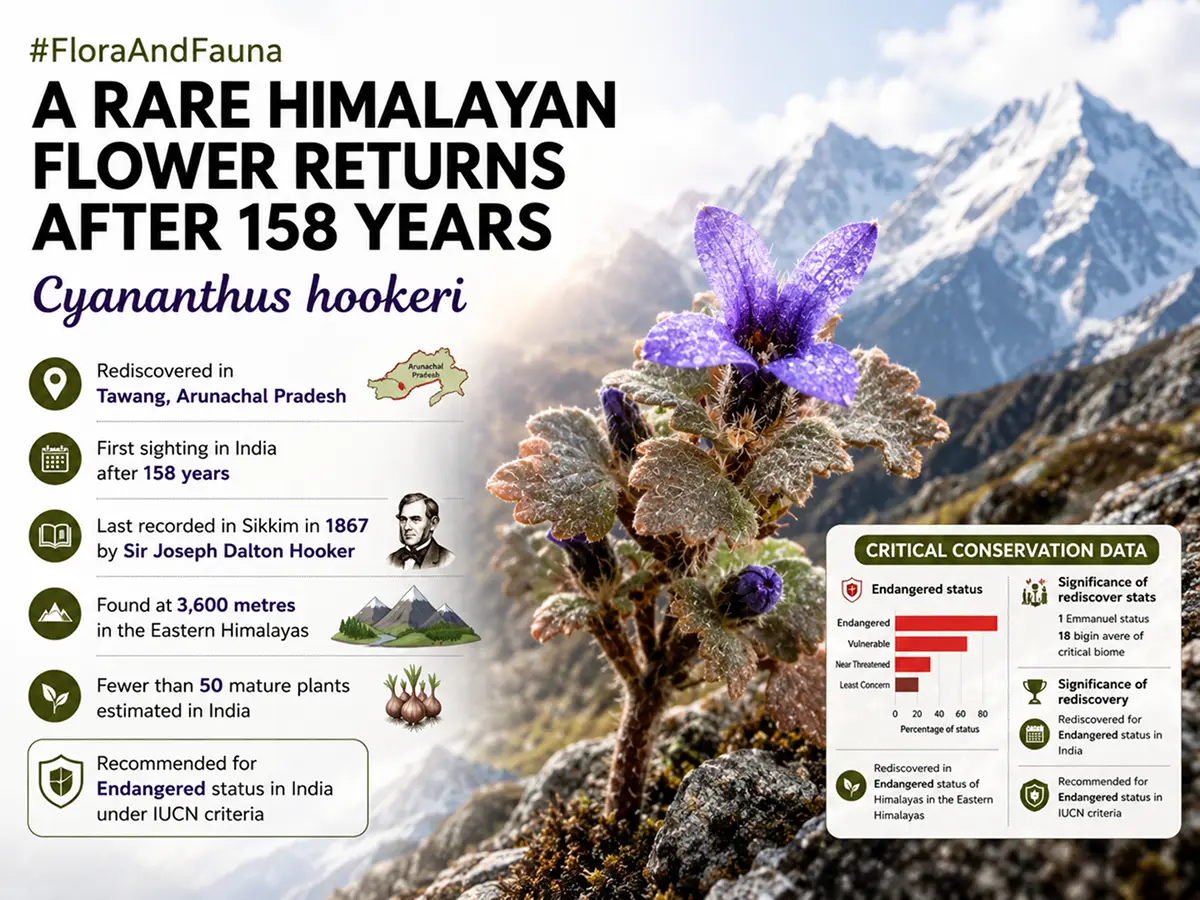
A rare blue flower has solved an almost two-century-old puzzle in Indian botany in the higher reaches of Tawang district, in the state of Arunachal Pradesh, close to the Chuna Valley area and about a kilometre away from Mago village. The plant, known as Cyananthus hookeri, was last documented in the Indian subcontinent way back in 1867, 158 years ago, before a team from the Botanical Survey of India rediscovered it in September 2025.
The species was discovered by researchers from the Botanical Survey of India, Subhajit Lahiri and Monalisa Das, under the guidance of Dr. Sudhansu Sekhar Dash. Found growing amidst the windy alpine terrain of grass and rocks at a height of about 3,600 meters, the plant falls under the category of Campanulaceae, also known as the bellflower family, which is identified by its small bell-shaped purple-blue flowers. What makes the species quite poetic in terms of history is that the first collection of the species in India was done by the British botanist Sir Joseph Dalton Hooker in 1867 in Sikkim, and the species bears his name.
These results, reported in the internationally recognized conservation journal Oryx, illustrate a high degree of rarity. The numbers of each population ranged from only three to seven mature plants, with less than 50 mature individuals estimated to persist in the entire nation. Due to such a high degree of vulnerability, it is suggested that this species should be categorized as Endangered at the national level according to IUCN Red List criteria.
Chowna Mein, Deputy Chief Minister of Arunachal Pradesh, hailed this discovery as a significant landmark for the botany of India since this discovery will add to the importance of the state in terms of being part of the Eastern Himalayan biodiversity hotspot that is recognised by the world. The scientific community views the rediscovery as a proof that even after over a century and a half of research, there are more species hiding in the distant Alpine meadows of the region.