





































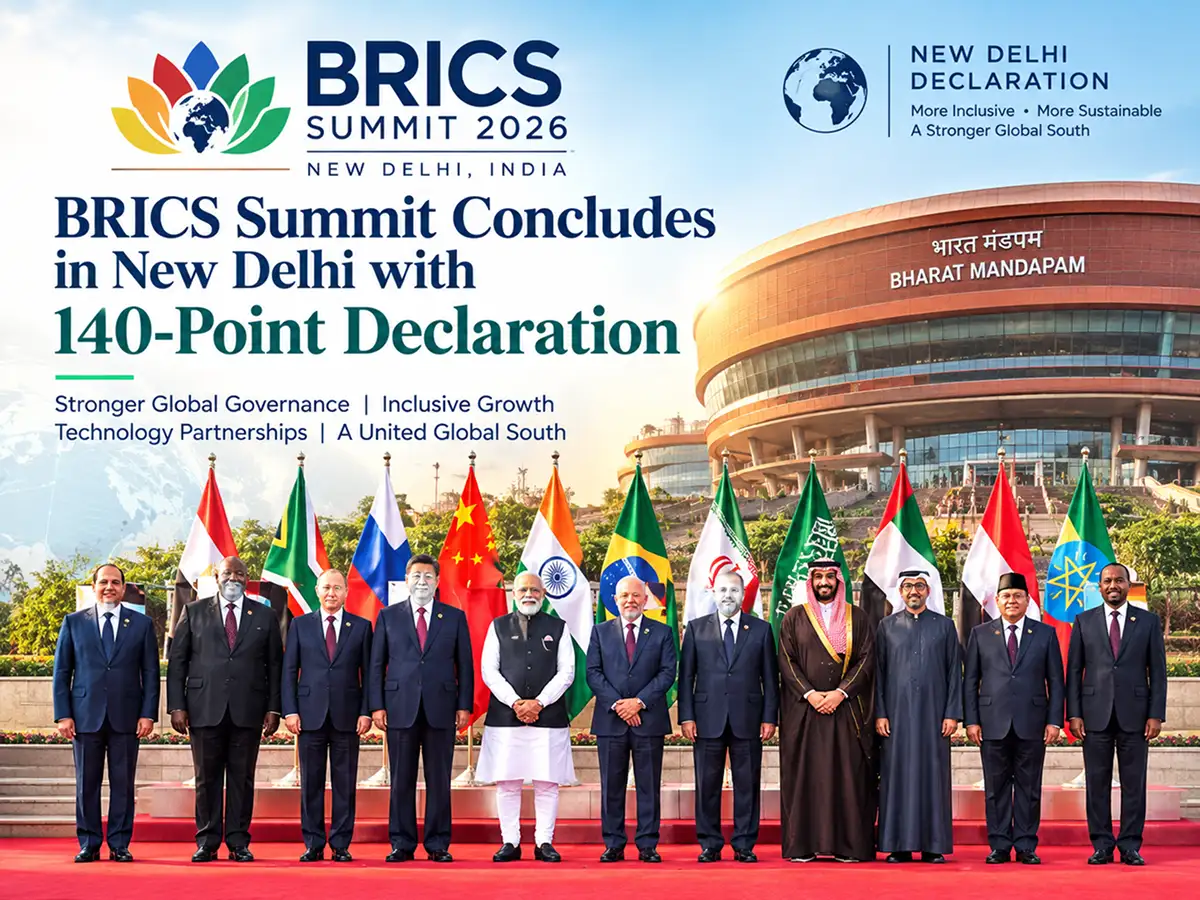
The 18th BRICS Summit came to a close at Bharat Mandapam in New Delhi on September 13 with the issuance of an all-encompassing New Delhi Declaration of 140 points, which talks about reforms of global governance, trade, technology, development, and concerns of the Global South in India's chairmanship of the year. The summit held over two days saw the presence of all 11 BRICS nations - Brazil, Russia, India, China, South Africa, Egypt, Ethiopia, Indonesia, Iran, Saudi Arabia, and the UAE. The group represents nearly half the world's population, 40 percent of world GDP and about 26 percent of world trade. The 2026 summit had additional significance as it marked 20 years since the formation of BRICS.
In terms of what happened behind closed doors, this declaration was the result of over 400 sessions held in more than 30 Indian cities, involving various ministries, agencies, firms, and civil society organisations, and resulting in more than 50 concrete achievements including trade facilitation and technology partnerships. In his address to the visiting leaders, the Prime Minister of India stated that the conference was “very productive and outcome oriented.” Hosting such a high-level conference in India, where there is a need to manage a group of countries having different diplomatic interests, was as much of a test of organisational capacity as it was of diplomatic acumen, and the results have been extremely positive for India, enhancing its image as a major player on the international scene as it hands over its chairship to China in 2027.